
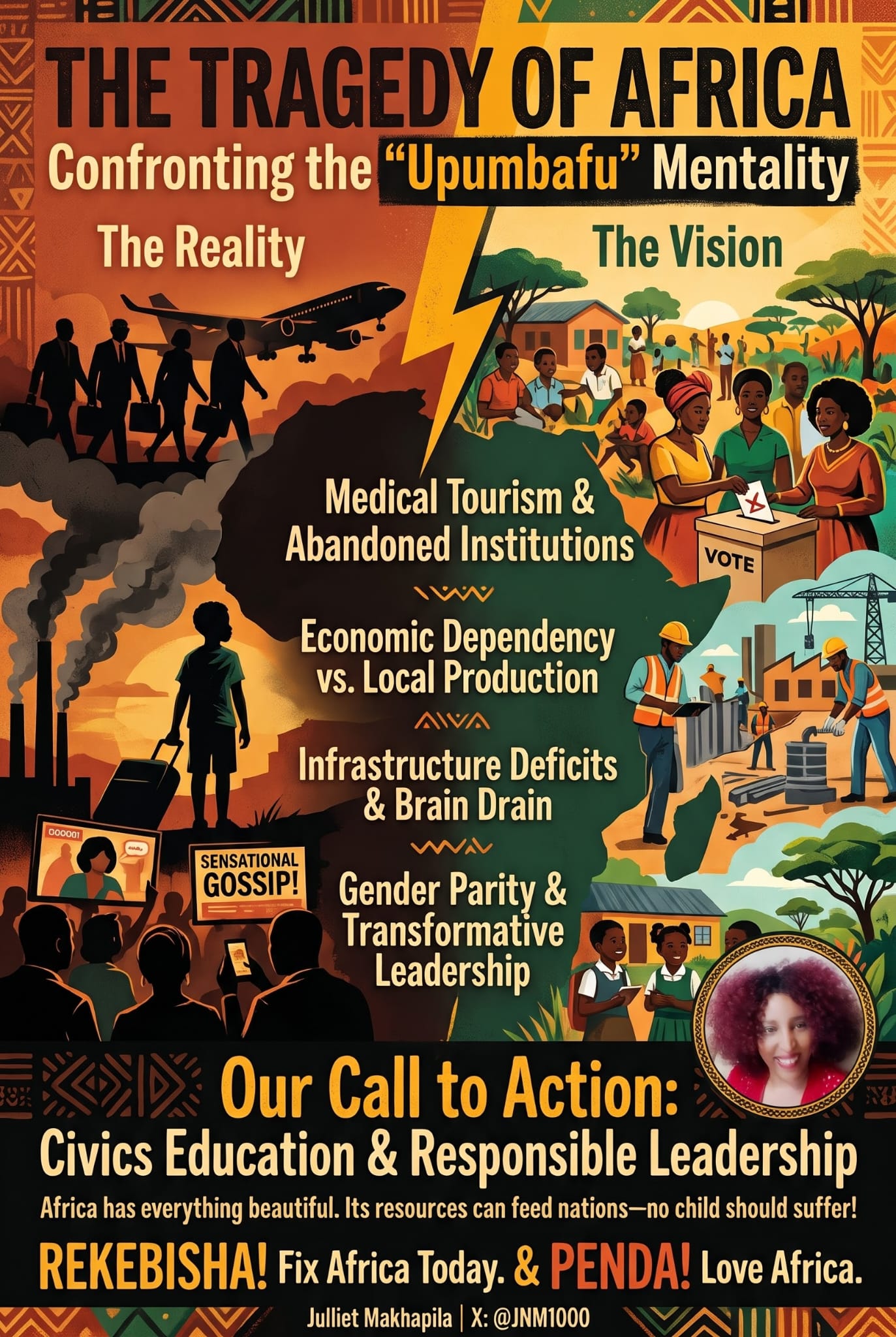
The Tragedy of Africa: Confronting the “Upumbafu” Mentality
Across parts of the African continent, an acute paradox defines public discourse: an insightful, well-researched article discussing systemic progress often struggles for readership, whereas sensationalized controversy or outrage commands immediate, widespread engagement. This reactive fixation—prioritizing spectacle over substance—exemplifies what can only be termed an “upumbafu” mentality: an entrenched mindset that avoids rigorous self-examination in favor of distraction, obstructing structural reform.
Medical Tourism and the Erosion of Institutional Trust
During election campaigns, political figures consistently pledge to construct state-of-the-art hospitals and revitalize national health systems. Yet, when faced with personal illness, these same leaders bypass domestic infrastructure to seek medical care across Europe, India, and North America. This practice exposes a glaring lack of confidence in the very institutions they govern and finance. By demonstrating that they do not trust the local clinics, equipment, or clinicians they expect citizens to rely on, leadership normalizes a culture of institutional abandonment and deepens public cynicism.
Economic Dependency and the Stigma of Local Production
Decades after formal independence, domestic manufacturing continues to struggle against an internalized bias favoring foreign goods. High-quality domestic products are frequently overlooked or undervalued unless stamped with foreign approval or imported from former colonial metropoles. This dismissive attitude toward local industry and craftsmanship stifles job creation, discourages entrepreneurship, and entrenches an unhealthy economic reliance on external markets.
Environmental Neglect and Compounding Inequality
Public health and environmental stewardship remain undermined by widespread complacency. From unchecked waste dumping and deforestation to the disregard of preventable diseases, ecological damage directly widens socioeconomic divides. When environmental destruction is treated with indifference rather than urgency, vulnerable communities bear the heaviest burden, entrenching cycles of poverty and ill health.
Infrastructure Deficits and the Continental Brain Drain
A significant portion of Africa’s youth actively seeks opportunities abroad rather than building careers locally. This migration is driven not by an absence of patriotism, but by the absence of foundational infrastructure. Decades after independence, numerous communities still lack reliable electricity, clean water, and adequate transit networks. Despite these chronic failures, political cycles frequently see the re-election of leaders responsible for prolonged stagnation, perpetuating a self-inflicted cycle of underdevelopment.
Gender Parity and Transformative Leadership
In several African societies, women continue to face systemic marginalization, relegated to secondary status in civic and economic spheres. True national development cannot occur while half the population is excluded from meaningful decision-making. Advancing women’s leadership requires structured policy interventions, closing gender wage disparities, and enforcing equitable representation—specifically working toward 50:50 parity in parliaments and executive bodies. Fostering equal leadership also demands that male allies actively champion systemic reforms that empower women, protect youth, and secure future generations.
Reclaiming the Continental Vision
The pervasive “upumbafu” mentality—manifested through political hypocrisy, infrastructural apathy, economic subservience, and gender inequity—stands as a primary impediment to continental advancement. It directly undermines Vision 2030 targets and broader continental frameworks such as the African Union’s Agenda 2063. Overcoming these barriers requires replacing passive acceptance with active civic accountability, domestic investment, and unyielding institutional integrity.
Our call to action Civics education awareness and Voters electing good Political Leadership who are responsible for serving its citizens .
Africa has everything beautiful .
The resources it has is enough to feed nations and no child or African family/continent needs to be suffering! A trailblaizer for the rest of the world .
‘Rekebisha’ Fix Africa today and “Penda ‘ Love Africa.






Leave A Comment